If want to see the complete version of our planning, please check the link and see the full planning book.
Introduction
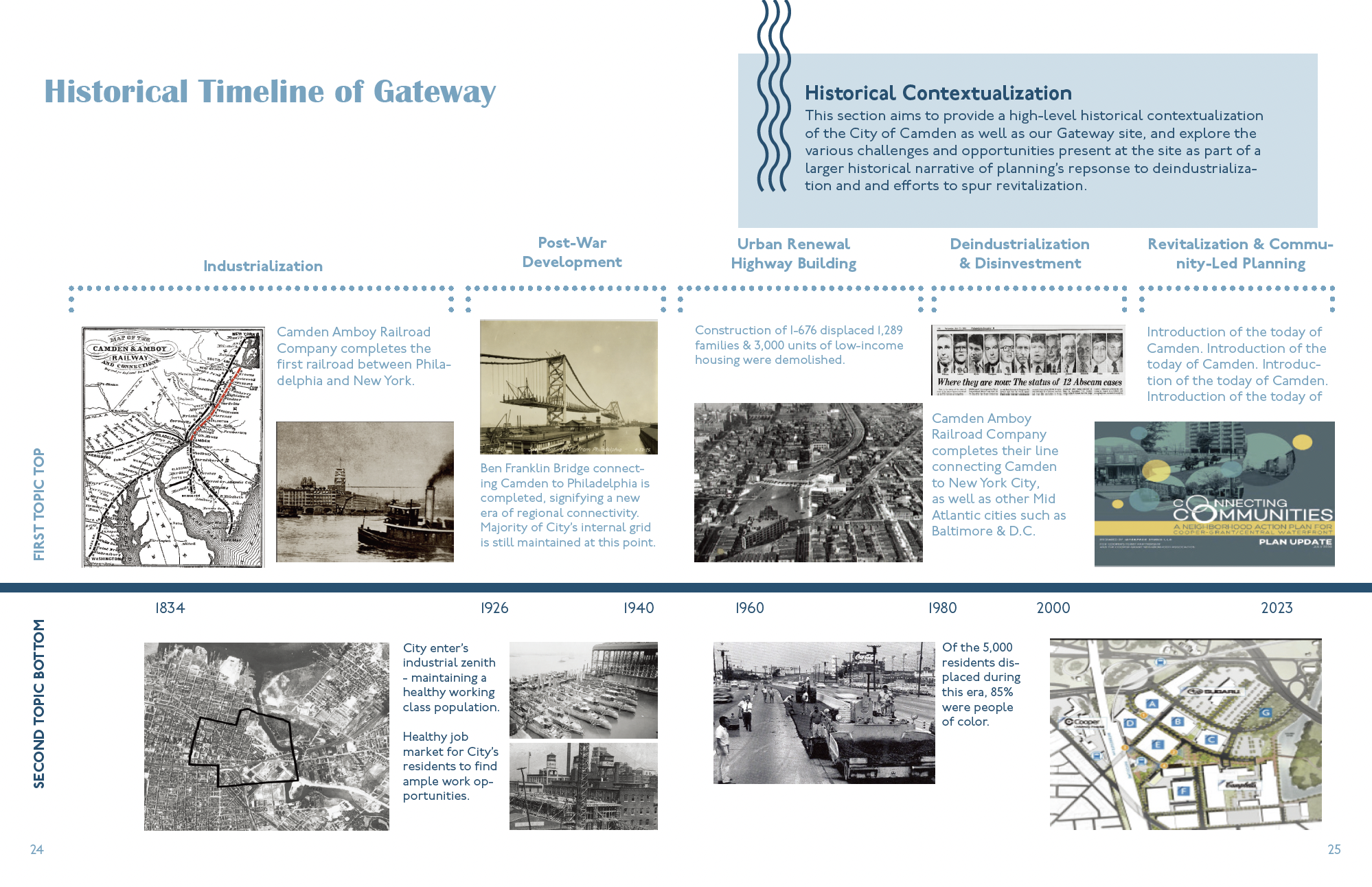
Camden, NJ, a historic and industrial urban center located directly across the Delaware River from Philadelphia, is in many ways a polemic example of the story of the post-industrial city. Once a key player in the most industrious region of the country, Camden was home to shipbuilding, canning, and many other manufacturing uses due to its proximity to markets, ports, heavy rail and related infrastructure. Like many similar Northeast and Midwest cities with an industrial and manufacturing past, the period of de-industrialization and urban renewal had drastically disparate impacts among Camden’s communities of color. Many of the challenges Camden still faces are attributable to the discrimminatory socio-economic doctrines and unjust political power imbalances that existed during these eras of urban development.”
Implementation
Highways are not inherently bad, but in the context of our study area, they consume a large percentage of area and are a barrier to local mobility. The I-676 and Admiral Wilson Blvd provide a greater regional mobility to largely non-Camden residents but at the cost of Camden residents. Symbolically, the highways memorialize the large-scale displacement of the 60s and the past half century of City turmoil. Camden residents have a lack of economic and social opportunities that are typically afforded to residents of other cities like those that use Camden’s highways. At the same time, Camden has a bright future. The recent wave of community-led neighborhood plans underline that Camden residents want to define Camden’s legacy. At the same time, the recent economic and transportation investments highlight that Camden is a city worth investing in. The issue is that this planning and investing are site and neighborhood specific. This siloed decision making is not addressing all of the factors at play. Although our plan is technically only for the Gateway District, we believe that this district can be a unifying force for Camden’s neighborhood planning and site investments. So even though we are creating a vision for the Gateway, our vision can affect the City as a whole.
Development Strategies
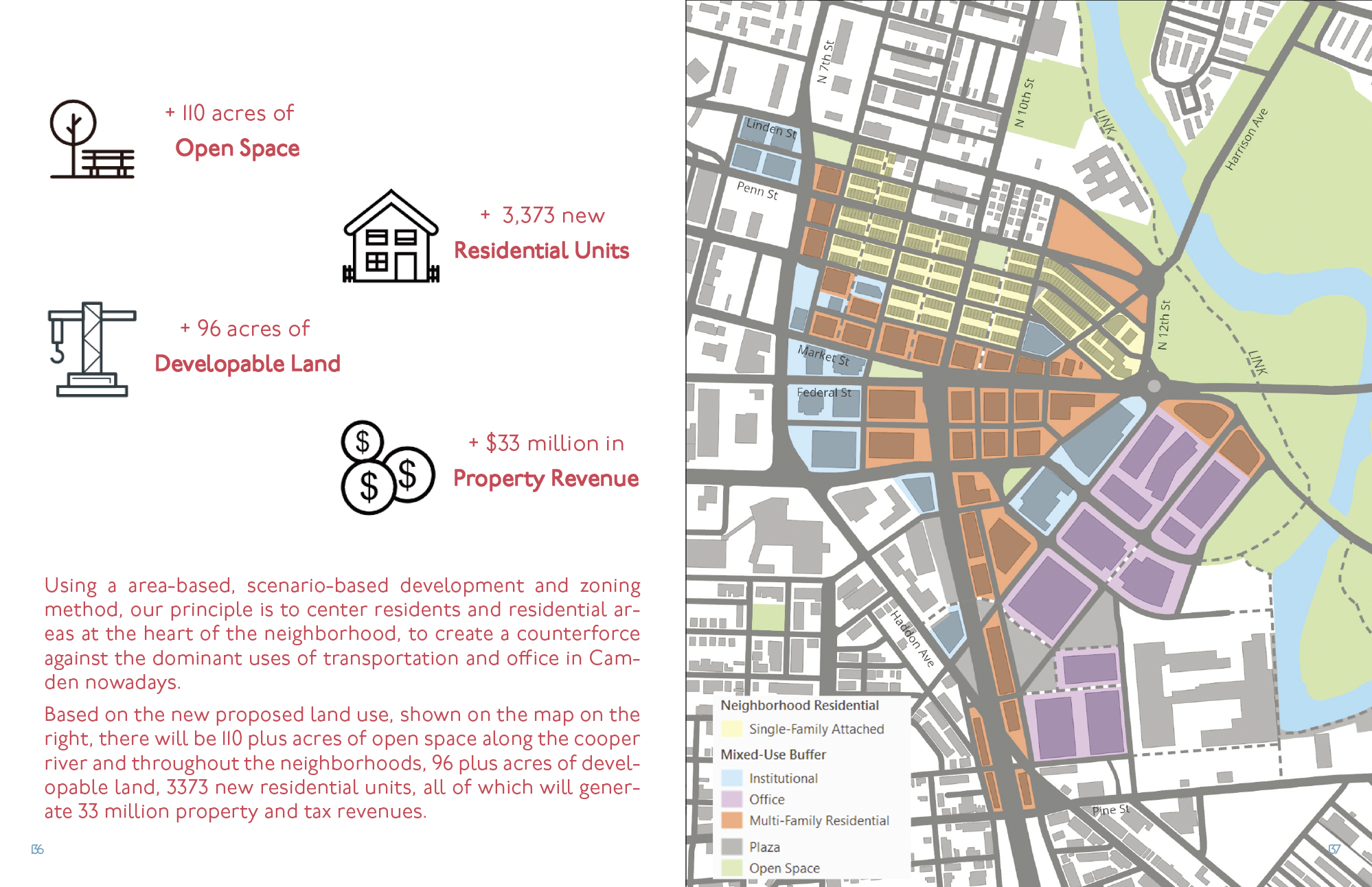
Using a area-based, scenario-based development and zoning method, our principle is to center residents and residential areas at the heart of the neighborhood, to create a counterforce against the dominant uses of transportation and office in Camden nowadays. Based on the new proposed land use, shown on the map on the right, there will be 110 plus acres of open space along the Cooper river and throughout the neighborhoods, 96 plus acres of developable land, 3373 new residential units, all of which will generate 33 million property and tax revenues.